
Local SEO blog
How to Find CBD SEO Keywords That Actually Bring Customers
September 6, 2026

I have worked in cannabis and CBD SEO since 2020, and keyword research is one of the first places I see brands lose the plot.
Someone opens Ahrefs or Semrush, types in “CBD,” exports several thousand keywords, and calls the job done.
That spreadsheet may look impressive. It can also be completely useless.
CBD keyword research starts with the business model, the products, the buyer, the location, the page you need to build, and the claims your compliance team will approve. Search volume matters. So does intent. So does the ability to publish a useful page without creating a regulatory headache.
I use the same basic process for CBD brands, hemp companies, retailers, manufacturers, and product suppliers.
Start with the business model
A CBD brand selling tinctures online needs a different keyword plan from a local wellness shop selling CBD topicals in Grand Rapids.
Before I open a keyword tool, I answer a few basic questions:
- What does the business sell?
- Who buys it?
- Does the business sell online, in a store, wholesale, or through distributors?
- Which products have healthy margins?
- Which states can the business legally serve?
- Which claims can the brand support and approve?
- Does the site need product pages, category pages, local pages, educational content, or all four?
A CBD manufacturer may need terms connected to private label CBD, wholesale CBD products, bulk CBD oil, and CBD product formulation.
A retailer may need CBD store, CBD gummies, CBD oil, CBD products near me, and local product availability.
A pet-focused company may research CBD for dogs, dog CBD oil, and pet CBD products. Those topics need careful review because animal health claims create their own compliance concerns.
The keyword list should reflect the business that exists. I do not build a strategy around products a company does not sell just because the keyword looks popular.
Understand the search intent behind CBD keywords
Search intent tells me what the person wants to do next.
I usually sort CBD keywords into these groups.
Informational keywords
The searcher wants an explanation.
Examples include:
- What is CBD?
- What is broad spectrum CBD?
- What is full spectrum CBD?
- How is CBD oil made?
- CBD dosage questions
- How to use a CBD topical
These terms belong in educational guides, FAQs, glossaries, and product education sections.
Some informational keywords sit close to a purchase. Someone searching “full spectrum CBD vs broad spectrum CBD” may be choosing between two products. A clear comparison guide can answer the question and link to the relevant categories.
Commercial investigation keywords
The searcher is comparing products, brands, or features.
Examples include:
- Best CBD gummies
- Organic CBD oil
- Full spectrum CBD tincture
- THC-free CBD gummies
- CBD brand reviews
- CBD oil for beginners
The word “best” creates a compliance review point. Product copy needs support for every meaningful claim, and comparisons need a clear method. A brand can discuss ingredients, serving size, extraction method, testing, format, flavor, and price without making unsupported treatment promises.
Transactional keywords
The searcher is ready to buy.
Examples include:
- Buy CBD oil online
- CBD gummies online
- CBD topical for sale
- Full spectrum CBD tincture
- CBD products with lab reports
- CBD wholesale supplier
These keywords usually map to category pages, product pages, collection pages, or wholesale landing pages.
A product page targeting “CBD gummies” needs actual gummies, useful product information, clear purchasing options, shipping details, testing information, and internal links to related products. A blog post cannot replace that experience.
Local keywords
The searcher wants a nearby business or a local product option.
Examples include:
- CBD store near me
- CBD shop Grand Rapids
- CBD products in Michigan
- CBD gummies near me
- CBD topical in [city]
- CBD delivery [city]
Local keywords can support Google Business Profile optimization, store pages, product availability pages, and location-specific content.
A local page needs real local value. Include the store address, hours, phone number, parking or access details, products carried, service area, and directions. A page with a city name swapped into the same paragraph fifty times gives visitors very little and can create a poor search experience.
Product and ingredient keywords
These keywords describe what the buyer wants.
Examples include:
- CBD oil
- CBD gummies
- CBD capsules
- CBD cream
- CBD balm
- CBD topical
- Broad spectrum CBD
- Full spectrum CBD
- CBD isolate
- Hemp-derived CBD
- THC-free CBD
These terms often belong on category and product pages. They can also create useful content clusters.
For example, a broad spectrum CBD category page could link to a guide explaining the difference between broad spectrum, full spectrum, and isolate products. That guide could link back to the products.
Problem-aware keywords
People often search for a product while describing a concern or desired experience.
Examples may include searches connected to sleep, relaxation, stress, discomfort, or recovery. These are also the keywords most likely to create health and medical claim problems.
I treat these as a compliance review category before treating them as an SEO opportunity.
The Food and Drug Administration says that only one prescription CBD product is approved, and the agency has warned companies about marketing CBD products with disease or treatment claims. The Federal Trade Commission has also said health claims require competent and reliable scientific evidence.
You can read the FDA’s CBD guidance and the FTC’s guidance on CBD health claims.
Search demand never gives a brand permission to publish an unsafe claim.
Use your own data before chasing new keywords
I start with Google Search Console when a site has existing organic visibility.
The Performance report shows queries that caused a site to appear in Google Search, along with clicks, impressions, click-through rate, and average position. Google explains the report in its Search Console documentation.
I look for:
- Queries with impressions and few clicks
- Pages ranking around positions 11 through 30
- Product terms bringing impressions to blog pages
- Local queries appearing for non-local pages
- Unexpected questions the site already answers
- Queries that reveal a page and keyword mismatch
A CBD brand may discover that its educational article receives impressions for “full spectrum CBD oil,” while its category page barely appears. That points to an internal linking and page-targeting problem.
Google Analytics helps connect organic landing pages to engagement and conversions. I also look at product performance, contact form submissions, and sales data when the client can share it.
Customer questions are excellent keyword research.
I pull ideas from support emails, live chat, product reviews, phone calls, social comments, retail staff, and internal site search. Customers use language that keyword tools often miss. They may ask, “Which CBD oil has no THC?” or “Can I use this topical on my feet?” Those questions can become content ideas, FAQ entries, or product page improvements after compliance review.
Expand the list with keyword tools
After I understand the business and existing demand, I use Ahrefs and Semrush to expand the list.
In Ahrefs, I review search volume, Keyword Difficulty, traffic potential, related terms, questions, and the pages already ranking. Ahrefs explains keyword research through concepts such as search intent, traffic potential, business potential, and difficulty.
In Semrush, I use the Keyword Magic Tool to review volume, keyword difficulty, intent, related phrases, and keyword groups. Semrush explains those features in its Keyword Magic Tool documentation.
I also use:
- Google autocomplete
- Related searches
- “People also ask” questions
- Competitor category and product pages
- Competitor content gaps
- Product catalogs
- Internal site search
- Customer reviews
- Search results from the target state or city
The numbers in these tools are estimates. Search volume and competition change with seasonality, product trends, platform changes, and consumer behavior. I check current data before making a publishing decision.
Evaluate business value and compliance risk
I score keyword opportunities using several factors:
- Search intent
- Product or service fit
- Business value
- Search volume
- Competition
- SERP features
- Compliance risk
- Page type required
A keyword with modest volume and strong buying intent may deserve more attention than a broad term with a giant number beside it.
“CBD oil” might look like the obvious target. It also attracts a wide mix of searchers. Some want definitions. Some want products. Some want dosage information. Some want a local shop. The SERP can include retailers, brands, marketplaces, medical resources, news, and educational pages.
A more specific phrase such as “broad spectrum CBD oil” may tell me more about the shopper’s needs. “Buy broad spectrum CBD oil online” shows even stronger purchase intent.
I inspect the current search results before assigning a keyword to a page. If product pages dominate, I build or improve a product page. If detailed guides dominate, I create an educational resource. If local map results dominate, I focus on local SEO.
The search results are the closest thing to a live brief.

Turn the keyword list into a site structure
Once I have the research, I map keywords to pages.
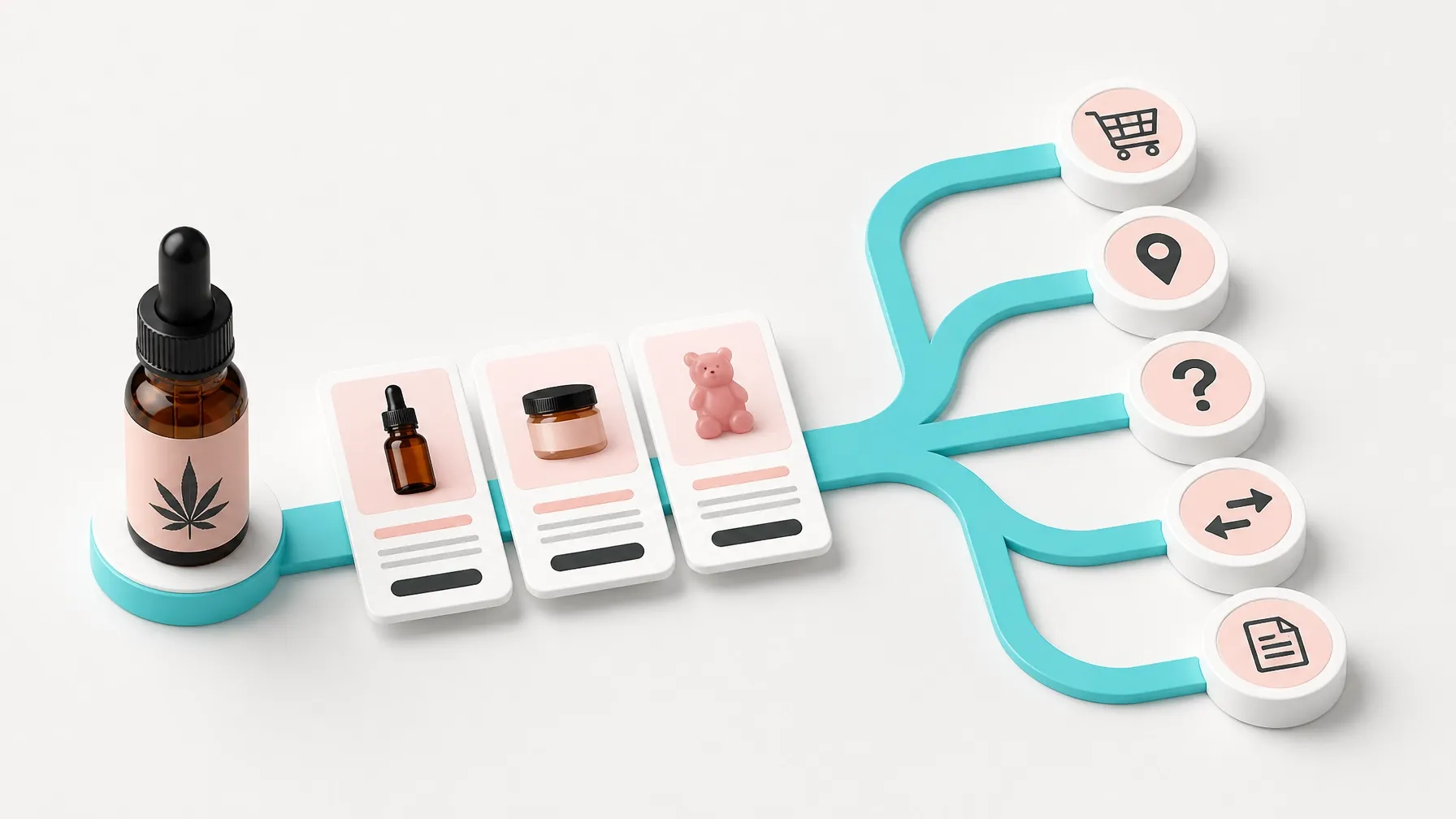
A basic CBD site structure might look like this:
- Category pages for CBD oil, CBD gummies, CBD topicals, and pet products
- Product pages for individual products and flavors
- Educational guides for CBD basics, ingredients, product types, and dosage questions
- Comparison pages for full spectrum CBD versus broad spectrum CBD
- FAQ sections based on real customer questions
- Local pages for real stores, service areas, and product availability
- Wholesale pages for suppliers, manufacturers, and business buyers
Internal links connect the pieces.
A guide about broad spectrum CBD can link to the broad spectrum category. A CBD gummies category can link to a guide about ingredients and serving information. A local store page can link to products available at that location.
Each page needs a clear job. Several pages targeting the same variation can split authority and confuse the site structure. I would rather build one genuinely useful page for a topic cluster than publish six thin pages that repeat the same paragraph.
Avoid these CBD keyword mistakes
Chasing only high-volume keywords
High volume can create visibility. It can also bring vague traffic from people who are still learning what CBD means.
Look for fit, intent, competition, and business value together.
Publishing restricted medical claims
Keywords connected to conditions and treatment can create serious problems. A compliance review belongs in the editorial process before publication.
Copying competitor keywords blindly
A competitor may rank for a term because of its authority, product range, location, backlinks, or years of content history. Copying the phrase does not copy the reason it ranks.
Study the intent and the page experience first.
Creating thin city pages
A city page needs real information for that location. Add useful local details, accurate business information, and content that reflects the actual service area.
Using one page for every variation
CBD oil, full spectrum CBD oil, broad spectrum CBD oil, and CBD oil for dogs may require different pages because the products and search intents differ.
The answer depends on the catalog, the audience, the SERP, and the compliance review.
Treating search volume as a promise
A keyword tool estimate is a planning input. It is not a traffic guarantee, sales forecast, or ranking promise.
My repeatable CBD SEO keyword process
Here is the process I use:
- Learn the business model and product catalog.
- Define the buyer and target locations.
- List product, ingredient, audience, comparison, local, and question-based terms.
- Pull existing queries from Google Search Console.
- Mine analytics, reviews, support emails, and internal site search.
- Expand the list in Ahrefs and Semrush.
- Search the current SERP for intent and page format.
- Review search volume, competition, business value, SERP features, and compliance risk.
- Map keywords to categories, products, guides, FAQs, and local pages.
- Build internal links between educational and commercial pages.
- Monitor the results and update the plan as demand changes.
CBD brands face advertising restrictions, shifting platform policies, and claim-sensitive copy requirements. Organic search gives them a way to earn visibility through useful pages that answer real questions.
That opportunity comes with responsibility.
I have worked around regulated products long enough to know that a ranking is never worth publishing a claim the business cannot support. Build the keyword plan around what customers need, what the company can sell, and what the brand can say responsibly.
That is how CBD keyword research turns into an actual search strategy instead of a very large spreadsheet nobody opens again.